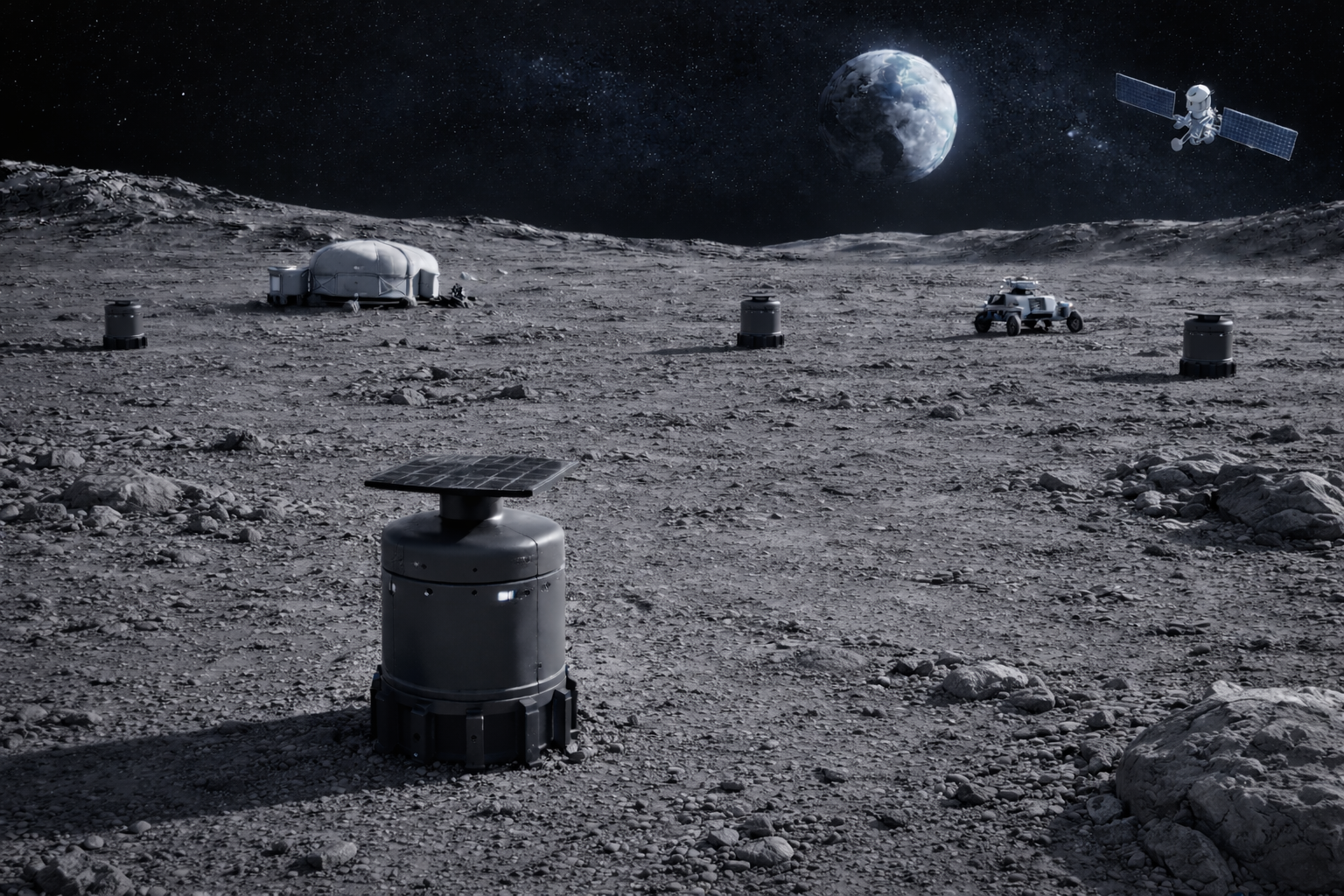

One of the most compelling advantages of a lunar seismic communication network — such as infrastructure concepts being explored by companies like SeismicComm — emerges on the far side of the Moon, a region permanently shielded from Earth’s electromagnetic noise.
Because the Moon is tidally locked, its far hemisphere never faces our planet. This natural barrier blocks terrestrial radio interference, creating the quietest radio environment in the inner solar system.
For decades, scientists have proposed placing radio observatories on the lunar far side.
The challenge has always been infrastructure.
How do you communicate with, power, and monitor observatories operating beyond direct line-of-sight with Earth?
A ground-coupled seismic communication network offers a novel solution.
Communicating Through the Moon Itself
By deploying seismic relay nodes across the lunar surface — from the near side to the far side — observatory data can travel laterally through the Moon’s crust.
Instead of relying solely on orbital relays, which are vulnerable to disruption or signal obstruction, data from a far-side lunar observatory could propagate node-to-node through regolith and bedrock until reaching Earth-facing transmission hubs.
This creates a hardened, persistent through-ground lunar communication system independent of satellite positioning.
Even if orbital communication assets were offline, far-side observatories would remain connected through the lunar seismic mesh network.
The Quietest Observatory in the Solar System
A far-side lunar radio observatory, supported by seismic communication infrastructure, could study signals impossible to detect from Earth, including:
- Primordial hydrogen emissions from the early universe
- Low-frequency cosmic background radiation
- Solar plasma wave activity
- Deep-space magnetospheric interactions
Earth’s ionosphere blocks many ultra-low-frequency signals. The far side of the Moon — shielded from both Earth and atmospheric distortion — provides an unparalleled deep-space listening post for cosmology and astrophysics.
A seismic communication backbone makes this observatory operationally viable and continuously connected.
Turning the Moon Into a Solar System Sensor Network
Because every node within a lunar seismic communications system also functions as a vibration sensor, the network doubles as a distributed monitoring grid — capable of observing both lunar and broader solar system events.
This dual-use infrastructure model is central to next-generation off-world network designs now being explored across the space industry.
Meteoroid Impact Detection
Without atmospheric burn-up, meteoroids strike the Moon directly.
A dense lunar seismic sensor array could:
- Detect impact location and magnitude
- Track meteoroid bombardment frequency
- Provide early warning for lunar bases
- Map ejecta and debris dispersal
Over time, this builds a real-time lunar impact monitoring system critical for infrastructure safety.
Deep-Space Event Monitoring
Large impacts and gravitational interactions create measurable vibrational signatures.
A sensitive moonwide seismic monitoring network could detect:
- Near-Moon asteroid flybys
- Tidal stress interactions
- Subsurface fracturing from thermal cycles
- Resonant vibrations from major impacts
In this role, the Moon becomes a passive mechanical listening instrument for nearby space events.
Helioseismic & Solar Storm Correlation
Solar flares and coronal mass ejections interact with planetary bodies in measurable ways.
While the Moon lacks a magnetosphere, solar radiation still produces surface and subsurface effects detectable through seismic monitoring technology.
A lunar seismic grid could correlate:
- Solar storm intensity vs surface vibration
- Particle flux vs regolith displacement
- Thermal shock propagation
This data enhances solar weather modeling essential for astronaut safety and mission planning.
Monitoring Human Activity Across the Moon
As lunar operations scale, the same seismic communication and sensing network could track human and robotic activity.
Seismic signatures allow differentiation of motion types, enabling monitoring of:
- Rover transit routes
- Excavation operations
- Habitat construction stresses
- Launch and landing vibrations
The Moon effectively gains a planetary logistics and activity monitoring system without reliance on GPS or orbital tracking.
Listening to the Interior of the Moon
A dense lunar seismic mesh network would produce the most detailed internal model of the Moon ever assembled.
It could refine understanding of:
- Core composition
- Mantle layering
- Lava tube stability
- Subsurface ice deposits
These insights directly support:
- Base placement planning
- Resource extraction
- Structural engineering
- Long-term habitation design
Infrastructure and planetary science converge within one sensing architecture.
Extending Seismic Networks Beyond the Moon
Once proven, planetary seismic communication systems — including those under development by firms such as SeismicComm — could expand across the solar system.
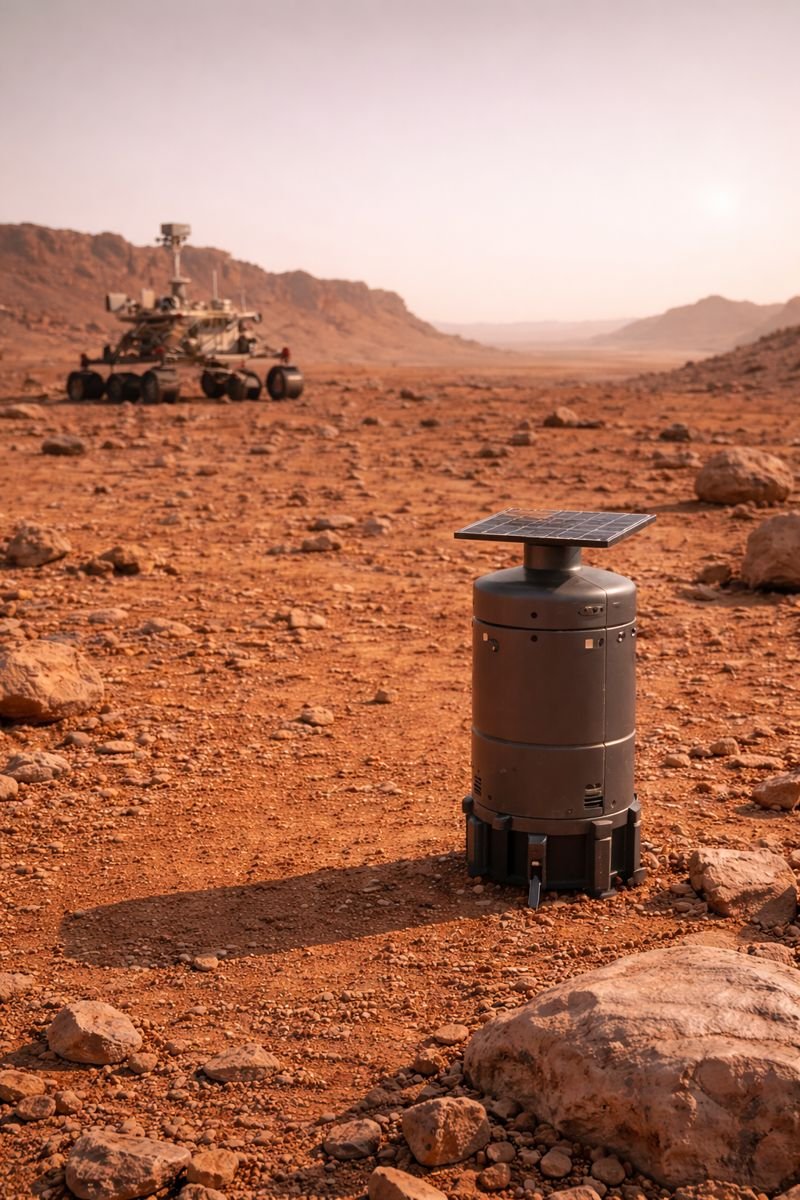
Mars Seismic Communication Networks
On Mars, seismic nodes could:
- Connect subsurface habitats
- Monitor marsquakes
- Track dust storm ground effects
- Coordinate autonomous mining systems
Asteroid Monitoring & Communication
On resource asteroids, seismic systems could:
- Map internal voids
- Monitor drilling stability
- Coordinate robotic excavation
Icy Moon Exploration
On Europa or Enceladus, seismic monitoring networks could detect:
- Subsurface ocean movement
- Ice shell fracturing
- Cryovolcanic activity
This transforms seismic communication into an interplanetary sensing architecture.
A Planetary Nervous System
Viewed at scale, a lunar seismic communication and monitoring network becomes more than infrastructure.
It becomes a planetary nervous system — transmitting information while sensing physical dynamics across an entire celestial body.
From far-side radio astronomy to meteoroid detection, from habitat monitoring to solar storm analysis, the Moon evolves into both a communications relay and a scientific instrument.
A listening post.
A monitoring grid.
A planetary sensor array.
All operating through seismic waves traveling beneath lunar regolith.
Conclusion
Establishing a seismic communication network on the Moon enables far more than subsurface connectivity.
It supports far-side observatories, monitors meteoroid threats, maps lunar interior structures, and extends sensing capabilities across the solar system.
As commercial and government efforts accelerate, organizations like SeismicComm are helping pioneer the foundational technologies that could make this planetary sensing and communication layer possible.